
What wood material is used for making H20 beam?
H20 wooden I-beams are widely used in construction formwork systems due to their excellent structural performance and durability, and their quality is largely determined by the wood materials and manufacturing standards.
4/3/20262 min read
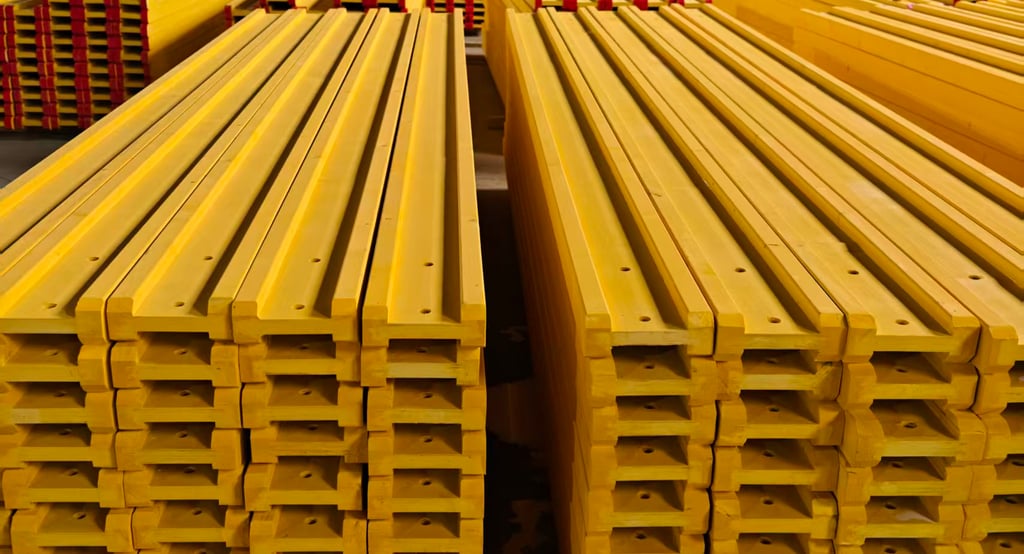
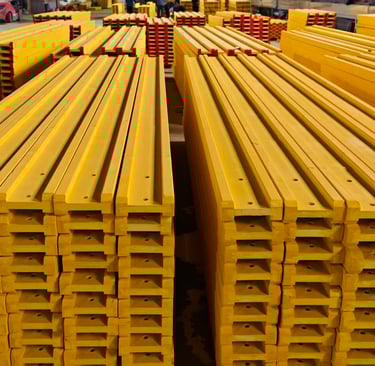
When asked “What wood material is used for making H20 beam?” the answer lies in the scientific combination of high-quality solid wood and engineered plywood, which ensures the beam’s strength, stability and long service life.
The two flanges of H20 wooden I-beams are made of solid Chinese fir, a premium wood material selected for its good toughness, high density and strong load-bearing capacity. Solid Chinese fir is not easy to deform or crack, which lays a solid foundation for the overall structural stability of the H20 beam. The middle web, which connects the two flanges and bears vertical pressure, is made of poplar-eucalyptus plywood bonded with phenolic glue. Phenolic glue is a high-performance adhesive with strong bonding force, heat resistance and water resistance, ensuring tight combination between plywood layers.
To ensure the beam’s quality and service life, strict requirements are imposed on the material moisture content, which is controlled between 8% and 12%. This range effectively avoids deformation, warping or cracking caused by excessive or insufficient moisture, ensuring the beam’s dimensional stability in different construction environments. In addition, the surface of H20 beams is treated with yellow waterproof paint, which enhances water resistance, prevents moisture erosion and extends the service life of the beam in harsh construction conditions.
During the manufacturing process, strict control is also carried out on the bonding quality and surface flatness. The surface lapping gap must be small, and the gluing must be uniform, which not only ensures the beam’s aesthetic appearance but also improves its overall strength and pressure resistance. Thanks to the high-quality materials and exquisite craftsmanship, H20 beams have excellent performance—they can bear large pressure without glue failure, meeting the needs of heavy-load construction scenarios.
The standard size of H20 wooden I-beams is 80*200mm, with strict dimensional tolerances to ensure interchangeability and installation accuracy. The thickness tolerance is controlled at ±1mm, and the length and width tolerance is ±2mm. These strict dimensional requirements ensure that the H20 beams can be perfectly matched with other formwork components, improving construction efficiency and structural safety.
In summary, the rational collocation of solid Chinese fir flanges, poplar-eucalyptus plywood web bonded with phenolic glue, and strict manufacturing and material control make H20 wooden I-beams a reliable choice in construction, perfectly balancing strength, durability and practicality.